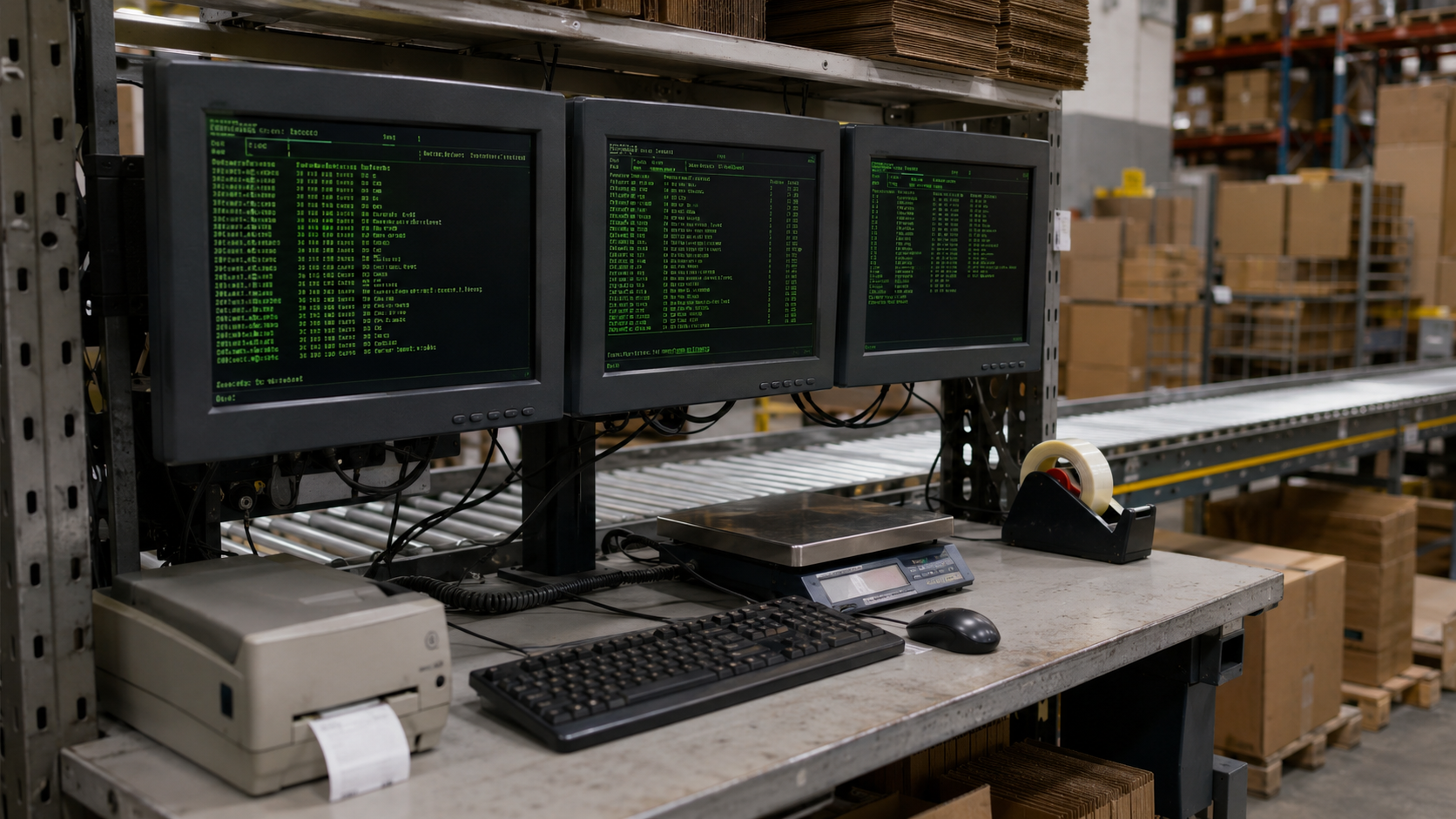
Every operations leader hits the moment. The WMS has been in place for years. It was the right choice at the time. But something has shifted. The complaints from the floor sound different now. The workarounds have multiplied. And you can't shake the feeling that the system is holding the operation back, not moving it forward. The question is whether that feeling is accurate, or whether the system is fine and the configuration just needs attention. Misreading that question costs money in both directions. Replacing a WMS you could have fixed wastes a year and a six-figure budget. Keeping a WMS you should have replaced wastes more than that, quietly, every quarter.
1. Your Order Profile Changed but the WMS Did Not
Five years ago, you shipped pallets to retail distribution centers. Today, you ship cases and eaches direct to consumers, or mixed pallets to small-format stores, or both. The WMS was designed for full-pallet pick, and it still works fine for full-pallet pick. But it has no native support for batch picking, zone routing, or pack station workflow. So the operation built those processes outside the system. The WMS thinks every order is a pallet. The floor knows better, and works around it.
This is the clearest sign the system no longer matches the business. When the picking methodology the WMS was built for represents a shrinking share of your volume, the gap widens every quarter. A system designed for a business you no longer run isn't fixable through configuration. The architecture itself is wrong for the work.
2. Integration Work Costs More Than the License
Every new integration, whether with an ERP, a carrier API, a robotics layer, or a customer EDI feed, requires custom middleware or a dedicated consultant. The WMS batch-processes data in an operation that now needs real-time signals. What started as one integration has become a tangle of point-to-point connections, each one fragile and expensive to maintain.
One operation we worked with had built three separate sidecar applications: a returns processing app, a receiving app to fill gaps in the WMS receive module, and a B2B pack-out app. Each one connected to the WMS through a single endpoint. The signals between them were so weak that a pallet would physically ship, the sidecar would record the shipment, but the WMS would cancel the transaction. Physical reality and the system record diverged regularly. The integration architecture had become the single largest operational risk, and maintaining it cost more annually than a modern WMS license that would have made the sidecars unnecessary.
3. You Run the Operation From Spreadsheets, Not the WMS
Labor planning happens in Excel. Slotting decisions happen in Excel. Customer compliance labels involve a manual lookup in a separate system, or worse, a binder. The WMS is a system of record. It knows what happened. But it isn't a system of action. The operation runs around it, not through it.
This pattern shows up most clearly in grocery and food distribution, where thin margins create a strong temptation to avoid SaaS costs by relying on spreadsheets and even pen and paper. The logic feels reasonable in steady state. What those spreadsheets never capture are the quality costs. Shrink that goes unexplained. Concessions to merchants when orders ship short. Errors that compound because no system flag catches them. Spreadsheets work until volume spikes, and then they do not. During peak, the gaps that were manageable at 50,000 cases a week become unmanageable at 80,000. The operation absorbs costs that never appear on any P&L line item labeled “spreadsheet error.”
4. Multi-Site Means Multi-Instance
Each facility runs its own copy of the WMS. Each 3PL client gets its own build. There is no consolidated view across them. Every new site is a full reimplementation because the architecture was never designed for multi-tenant or multi-site operation. Reporting across sites means pulling data from each instance separately and stitching it together manually.
Centralized dashboards that pull from each instance can help in the short term. But they are a patch, not a fix. The consolidated operational view should live in the WMS itself. When every new site or client requires a full reimplementation, the scaling cost is not marginal. It is linear, and it only gets worse.
5. The Vendor Stopped Investing in Your Problem
The product was acquired and the roadmap shifted to a different industry. Or the vendor hasn't released a meaningful feature update in two years. Or the features they do release target a use case you don't have. You are paying annual maintenance for a tool that won't solve your next three years of operational challenges.
This is harder to quantify than an integration failure, but it is more dangerous. A system in maintenance mode stops adapting. The gap between what the system does and what the operation needs widens slowly enough that it never triggers a single decision moment. But it shows up in every hiring conversation, every throughput target, every quarter where labor cost per order ticks up without explanation.
6. Customer or Regulatory Requirements Now Exceed the System
You need ASN compliance for a major retailer. Or SSCC labeling. Or serialization and lot-level traceability for a regulated product category. Or cold-chain documentation that holds up to an audit. The WMS either can't produce these outputs, or produces them unreliably enough that someone on the floor double-checks every one. Compliance risk becomes the forcing function. When a single missed label or traceability gap can cost a customer relationship or a regulatory finding, the system has crossed from inconvenient to untenable.
When It Is Actually a Configuration Problem, Not a System One
Not every frustration with a WMS means the platform needs to be replaced. Some problems look like system limitations but are really configuration gaps. Misdiagnosing these costs time and money. Here are three that routinely get mistaken for signs the WMS is failing.
1. “Pick Rates Are Too Low”
Rarely a system problem. In most cases, slotting is stale. Pick paths haven't been re-sequenced in years. Travel time is not reflected in labor standards. A new WMS won't fix a bad slotting strategy. Before concluding the system is the bottleneck, check whether the fastest-moving SKUs are still in the forward pick locations they were assigned to 18 months ago. Velocity shifts. Slotting usually doesn't. That is a process problem, not a platform one. We covered this in more detail in our article on why slotting strategy decays and what it costs in pick rate.
2. “Inventory Accuracy Keeps Drifting”
This is almost always process discipline, not system capability. No consistent cycle count cadence. Receiving verification is loose. Directed putaway rules were configured once and never updated, even after the DC was re-racked. The WMS has the tools to enforce inventory integrity. They are either not turned on or not enforced. A new system won't fix a culture of bypassing verification steps.
3. “We Cannot Get Good Reports Out of the WMS”
Most WMS platforms capture the data. The problem is typically that no one configured the report templates, documented the data dictionary, or defined what “good” looks like operationally. A BI layer or proper report configuration usually fixes this faster than a migration ever would. Before you replace the system, ask whether anyone on your team can explain what data the WMS already captures and where it lives. If the answer is no, the reporting gap is probably not the vendor’s fault.
What to Do With This List
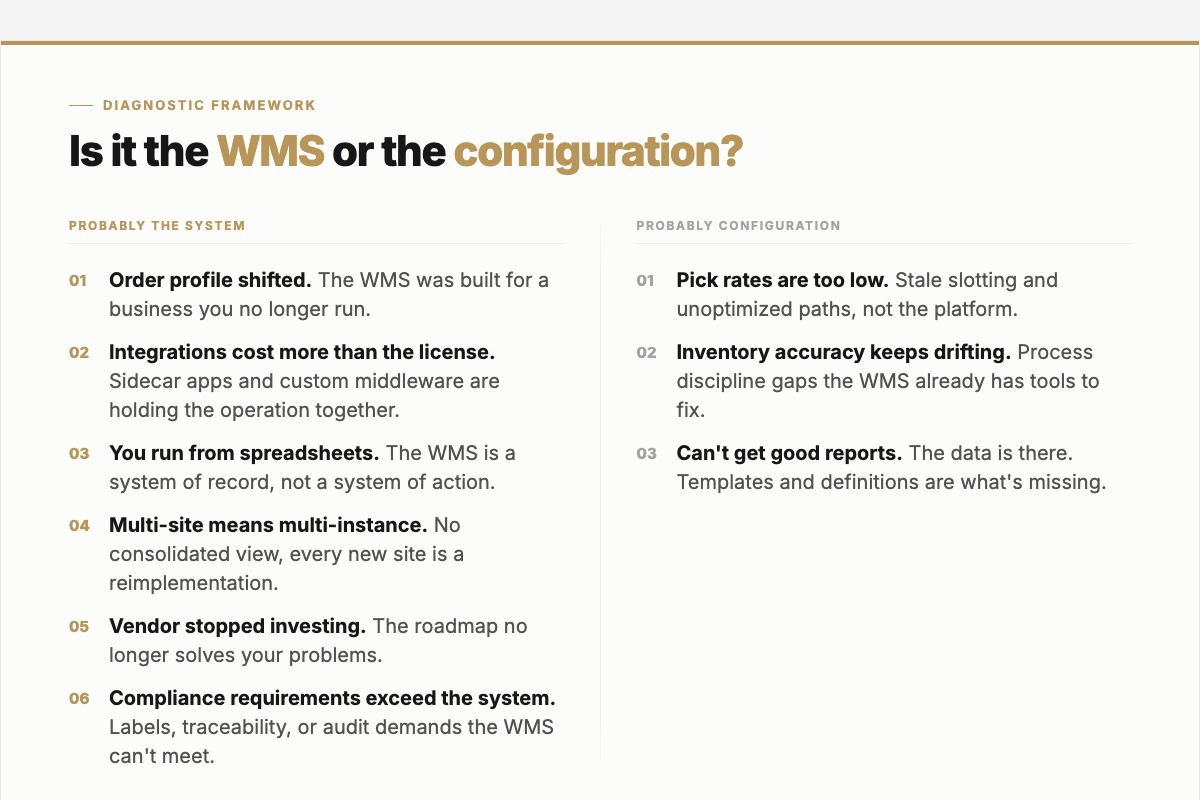
If more of the first six signs apply to your operation than the last three, the platform is probably the constraint. That doesn't mean you need a new WMS tomorrow. It means the cost of staying put, in integration overhead, in spreadsheet-driven operations, in compliance risk, is higher than the cost of moving. And it means those costs are accruing quarterly, whether or not a line item exists for them in the budget. We broke down those hidden costs in In-House or Consultant? What a WMS Migration Actually Costs.
If more of the last three apply, the system may have more life in it than it looks like from the daily complaints. A configuration review and a refreshed slotting strategy often produce more throughput improvement per dollar than a platform migration. Both paths benefit from an honest assessment before committing to either one. The cost of getting the diagnosis wrong is larger than either fix.