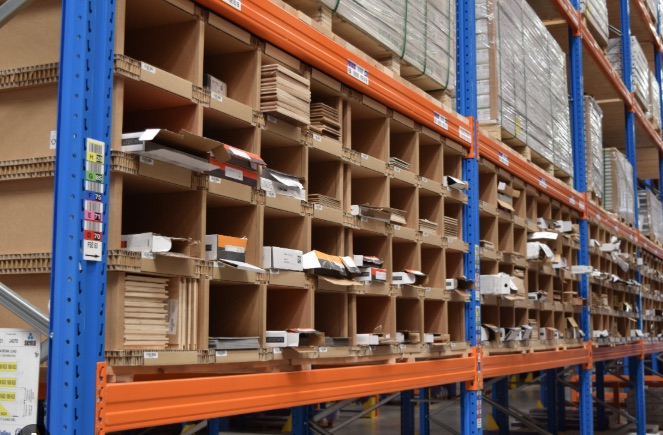
"It's sitting right there but I'm getting an error when I try to pick it." An associate is standing in front of a bin that was reslotted two weeks earlier, staring at a WMS screen that shows a locked location.
The lock went on before the move so pickers couldn't work the new slot while product was in transit. No one released it once the pallets landed. The location has been fully stocked and completely unusable for twelve days, not because anything is missing, but because a single flag from the reslot never got switched back.
What a Reslot Actually Changes in the WMS
In the WMS, a reslot changes the location assignment and the attributes that drive work after the physical move. Those records influence every directed putaway, pick, replenishment, and cycle count touching that SKU from that point forward. Update the system as the product moves and future tasks follow the new layout. Let the records fall behind and the WMS keeps creating work against locations that no longer hold what it expects.
Most reslotting projects exist because slotting decisions go stale. Deciding what to move is usually the easy part once the data is in front of someone. The hard part is execution. The risk sits in how the move gets executed against a system that's still directing traffic based on the old layout while the new one is only half in place.
WERC's 2026 DC Measures Report includes inventory count accuracy by location among its core warehouse quality measures. A reslotting project puts that location-to-inventory link under controlled pressure. How the work gets sequenced decides whether accuracy recovers cleanly once the move is done, or the operation spends the next several weeks chasing variance that traces straight back to it.
Run the Payback Test Before Moving Inventory
A warehouse doesn't need to reslot every time a SKU velocity report changes. The move earns its keep when the recurring cost of the current slot is greater than the labor, disruption, and inventory risk of changing it. That case may come from excess travel, repeated emergency replenishment, congestion, poor ergonomics, or errors tied to the location. If those costs are not visible in the data, the project may only create activity.
Suppose a controlled move costs $5,000 in labor and verification work, then removes $8,000 of recurring handling cost in the first week. The payback is easy to defend. If the same $5,000 produces a small, uncertain saving over several months, leave the slot alone and work the larger constraint first. The figures are meant to illustrate the potential cost savings. The decision should use the operation's actual travel, replenishment, error, congestion, and move-labor data.
Reslot Decision Guide
When a reslot earns the disruption
Fast movers sit far from pack-out or deep in reserve, and the travel penalty persists across normal demand.
Travel and handling time are stable, and another location would only move congestion somewhere else.
Forward pick slots trigger frequent emergency replenishment or run dry during ordinary waves.
Replenishment frequency is manageable and the slot still covers the operating window.
SKU velocity, cube, or order affinity changed enough that the current placement no longer fits how orders are built.
A promotion, season, or single customer caused a short demand spike that has not become a stable pattern.
Congestion, extra touches, mis-picks, or ergonomic problems cluster around a small set of locations.
Allocation rules, replenishment logic, labor, or pick-path configuration is the real constraint. Moving product will not remove it.
Measured savings in travel, replenishment, and errors can repay the move labor and verification work in an acceptable window.
Expected savings are small, uncertain, or depend on demand that may disappear before the move pays back.
When a Rolling Move Is the Right Call
Shutting the floor down to reslot in one pass sounds safer than doing it live. In practice it rarely is. A full freeze concentrates risk into a single weekend and pushes a facility's entire task volume through one cutover window. That's what can turn a small sequencing mistake into a large one. Phased moves, zone by zone, starting with the highest-velocity SKUs, usually carry less risk and deliver more of the benefit early.
Running the reslot live, while the rest of the floor keeps working, is usually the right call. The cost shows up as calendar time. Each phase stays small enough to verify before the next one starts, and a mistake in zone three doesn't contaminate the data for zones one and two.
Treating each phase as a set of WMS-directed relocation tasks, instead of a checklist the team works from memory, is what makes a rolling move safe. A well-configured relocation workflow controls the source inventory and requires confirmation at the destination before the new slot becomes available. That mechanism catches the exact failure mode described above before it spreads across the floor.
When the WMS Can't Create a Relocation Task
Not every WMS has a relocation task to lean on. Some platforms, especially lighter WMS modules bolted onto an ERP, don't have a move transaction between locations at all.
Check for a manual move first. Many systems without a directed relocation task still have a move transaction an associate can start from an RF scan. It still validates the inventory in real time and ties the old location to the new one in a single record. It does the same job a relocation task would.
If neither option exists, the workaround is a paired transaction. Adjust the SKU out of the old location, then put it away in the new one as if it had just arrived. It works, but it creates a different record than a move does. A move ties both locations together in one transaction. Two adjustments don't, so a ledger review later shows an unexplained shortage in one spot and an unexplained receipt or adjustment in another.
That gap is often bridgeable. Tag both sides of the pair with the same reason code, tied to the reslot phase, and verify the location the same day. Without that link, the location runs on the honesty of whoever made the move and nothing else.
Where the Sequencing Breaks
The pattern that leaves a location stuck usually starts as routine process. Placing a hold on a destination ahead of a move keeps a picker from getting sent there mid-transition. That part works fine. The gap opens at the other end of the phase, when the move finishes and nobody works back through the hold list to release what's now safe to pick.
The same failure runs in reverse when a physical move happens with no task behind it at all. A team falls behind on a zone. A supervisor tells two associates to carry the remaining pallets to their new homes so the phase stays on schedule, and the move happens as a physical action with no relocation task tracking it. The WMS still has the old location on record. It keeps directing pickers there, keeps assigning cycle counts against a spot that's now empty, and keeps letting replenishment route inventory into a location that's supposed to be retired.
The system has no way to know a destination hold outlived its purpose, or that the floor moved faster than the task did.
Reslot Move Sequencing
Floor action versus the WMS action it depends on
- 01Control the moveWhat the floor doesNothing physical yet. The team identifies the source inventory and destination slot.What the WMS needsThe source quantity and destination get the right controls so new tasks cannot conflict with the move.
- 02Physical moveWhat the floor doesProduct gets carried to the new location.What the WMS needsA relocation task should track the move. A verbal instruction to two associates is not a task.
- 03Confirm arrivalWhat the floor doesNew location is fully stocked and ready to work.What the WMS needsThe relocation gets confirmed, tying the inventory record to the destination location.
- 04Release or retireWhat the floor doesThe team moves on to the next zone in the phase.What the WMS needsThe new slot becomes pickable. The old slot is either released for reuse or kept unavailable if it is being retired.
What a Mis-Sequenced Move Costs
A handful of unsynced locations after one phase won't sink an accuracy program on its own. The cost comes from how long the gap goes unnoticed. A location that's wrong for a day usually gets caught on the next cycle count. A location that's wrong for three weeks can create dozens of misdirected tasks.
Each one turns into a mis-pick, a failed pick that an associate overrides by hand, or phantom inventory that shows up as an unexplained shortage during month-end close. That accumulates. It shows up as a slow drift in the accuracy number that nobody connects back to the reslot that finished three weeks earlier. That's what a disciplined exception resolution process is built to catch before it reaches the books.
Three outcomes are possible here.
A reslot executed as system-directed tasks, with holds released the moment product lands, is operational intelligence. It tells the WMS exactly what changed and when, and the record stays trustworthy through the move. A reslot that starts drifting into manual carries and unreleased holds is configuration feedback. It's telling the operation that the phase plan outran the team's capacity to keep the system current, and slowing down is cheaper than absorbing the fallout later. A reslot that finishes with locations still unreconciled, and nobody assigned to close them out, is risk sitting on the books, waiting for the next count to surface it as a variance nobody can explain.
A Reslot Finishes When the System Says So, Not the Floor
Before calling a phase done, pull the pick and putaway transaction history for every location the phase touched, covering the following five to seven working days. A retired location still generating directed tasks, or a new location still flagged on hold while it's actively being picked, means the move isn't finished. That single check catches most of the drift before it turns into a variance nobody can trace. Trust the transactions.
Treating a reslot as a physical logistics problem, moving the pallets and updating the map, is reasonable. But it's also incomplete. The floor can execute a move perfectly and still leave the WMS working from an old picture of the building. Sequencing the move as a list of WMS-directed tasks decides whether the reslot pays off in pick rate or resurfaces three weeks later as an inventory accuracy problem with no obvious cause. Run it as a side project the team works around the system, and the second outcome is the likely one.